Quick Summary
CASA drone regulations apply to any drone flown for business, including paid work or flights that support a business activity such as mapping, inspections or farm checks. Your drone's weight with batteries and payload, and where and how you fly, decide which approval pathway you need. Keep a written risk assessment and flight records for every business flight.
- Business flights follow CASA rules even when the drone is small.
- Weigh the drone with batteries and payload fitted, not the bare airframe.
- Stay in the excluded category only if every operating limit is met.
- Check airports, helipads and controlled airspace before each flight.
- Complete a pre-flight risk assessment and keep a flight log for each job.
Table of Contents
- Why CASA Rules Apply to Your Business Drone Work
- Recreational or Business: Which Rules Apply to Your Flight
- Drone Licence Requirements for Business
- Excluded Category Drone Operations: Who Qualifies
- Weight, Altitude and Distance Limits to Check Before Every Flight
- Airports, Controlled Airspace and Helipads: Where You Cannot Fly
- Commercial Drone Risk Assessment Checklist for Farm and Site Work
- Drone Operations Manual and Flight Records You Should Keep
- Insurance, Incidents and What to Do If Something Goes Wrong
- Your Next Step: Getting Your Drone Operation Compliant
- Frequently Asked Questions
Why CASA Rules Apply to Your Business Drone Work
If you use a drone to make money on your farm, your site or for a client, the Civil Aviation Safety Authority (CASA) regulates how you fly it, and knowing the rules before you lift off keeps you out of trouble. Using a drone for business is not the same as flying one for fun, and CASA treats the two very differently.
This guide from DRONES180 walks through the CASA rules in plain terms, so you can work out what applies to your operation before you lift off.
CASA is Australia's aviation regulator. Its rules cover who can fly, where they can fly, how high and how close to people and property, and what records you need to keep. Mapping a paddock, checking irrigation, inspecting a shed roof or surveying a building site all count as business use if you are paid for the work or it supports a business activity.
Many operators assume that a small drone escapes the rules. That is not the case. Weight thresholds change which rules apply, but a drone used for business still needs to be flown within CASA's framework.
Recreational or Business: Which Rules Apply to Your Flight
The first question to answer is whether your flight is recreational or commercial. The purpose of the flight decides this, not the size of the drone.
A recreational flight is for pleasure, with no payment and no business benefit. A business flight involves money changing hands, or the footage and data supporting a commercial activity, such as checking crops you sell or inspecting assets you manage.
Treat these as business flights:
- Spraying or spreading on a farm you operate
- Mapping a property for a development or sale
- Thermal checks on infrastructure you manage
- Flying for a client, even once and even for free
If there is any doubt, assume the business rules apply. The cost of getting this wrong is a fine or an insurance problem, which is far more expensive than doing the paperwork.
Drone Licence Requirements for Business
Business drone use generally requires the right CASA approvals for the operation, and the operation itself needs to be planned and assessed. The exact pathway depends on the weight of your drone, where you fly and how risky the operation is.
In practice, most business operators need to:
- Hold the CASA approvals appropriate to the operation
- Assess the risks of each flight before it takes off
- Keep records of planning, maintenance and flights
Check the current requirements on the CASA website before you start, because the rules and licence classes are updated periodically.
Excluded Category Drone Operations: Who Qualifies
The excluded category is a simpler pathway for low-risk business drone work, but it is not a free pass. It can cover some small drone flights for business, provided you meet every condition every time you fly. If you cannot tick all the boxes, you move up to a higher approval pathway.
Think of it as a set of gates. You only stay in the excluded category if you pass through all of them on each flight.
The weight gates
CASA splits small drones into two weight bands for business use, and the band is based on the drone's weight with batteries and payload fitted, not the bare airframe.
Weight bands and their conditions change, so check the current CASA weight limits for your drone with batteries and payload fitted. If your drone is heavier than the limit CASA sets for the excluded category, you will need a higher pathway.
The operating gates
Even if your drone is light enough, the flight itself must stay inside these limits:
-
Visual line of sight at all times, you must see the drone directly, not through binoculars, a screen or a spotter's eyes alone.
-
Not over or near people, you must not fly over people who are not part of the operation, and you must keep clear of crowds.
-
Away from controlled airspace and aerodromes unless you have the required authorisation.
The record gates
Even in the excluded category, you are expected to keep basic records: your risk assessment for each flight, your flight log, maintenance notes and incident records. These are covered in more detail in the records section below.
When to step up a pathway
Move up from the excluded category when any of these apply:
- Your drone weighs more than 2 kg with batteries and payload.
- You need to fly beyond visual line of sight.
- You need to fly over people or in controlled airspace.
- You want to fly at night or in conditions outside the excluded limits.
- Your operation involves higher-risk work such as spraying, carrying loads or flying near infrastructure.
A quick decision path
Use this order to work out your pathway:
- Weigh the drone with batteries and payload.
- Check whether the flight stays inside the excluded operating limits.
- If both answers are yes, you can generally operate in the excluded category with basic records.
- If either answer is no, you need operator accreditation and a remote pilot licence (RePL), or another approval pathway.
This is the same logic CASA uses, and it is the fastest way to avoid over- or under-buying your compliance setup.
Weight, Altitude and Distance Limits to Check Before Every Flight
Before every flight, confirm the limits under the casa drone regulations that apply to your drone and your site. These are the figures that most often catch operators out.
-
Weight: Check the weight with batteries and payload fitted, because that is the figure that counts against CASA's current limits.
-
Visual line of sight: You must keep the drone in sight without aids such as binoculars. A spotter can help, but the rules on this are specific.
-
Distance from people: Keep clear of people not involved in the operation. Distances change with the type of operation, so confirm yours.
-
Distance from property: Do not fly over other people's property without permission.
Write these limits into your pre-flight checklist so they are checked every time, not just the first time.
Airports, Controlled Airspace and Helipads: Where You Cannot Fly
Certain airspace is off limits or restricted. Airports, controlled airspace and helipads can all affect where you fly, even on your own land.
Before you fly, check whether your site sits near an airport, a helipad or any controlled airspace. Use an approved location-checking app or the official airspace tools to confirm. Near some farms and regional strips, the restriction may be closer than you expect.
Flying in restricted airspace without authorisation is one of the most serious breaches, so this check is not optional.
Commercial Drone Risk Assessment Checklist for Farm and Site Work
A risk assessment is how you show you have thought about the flight before it happens. Make it a habit, and keep a copy with your flight records.
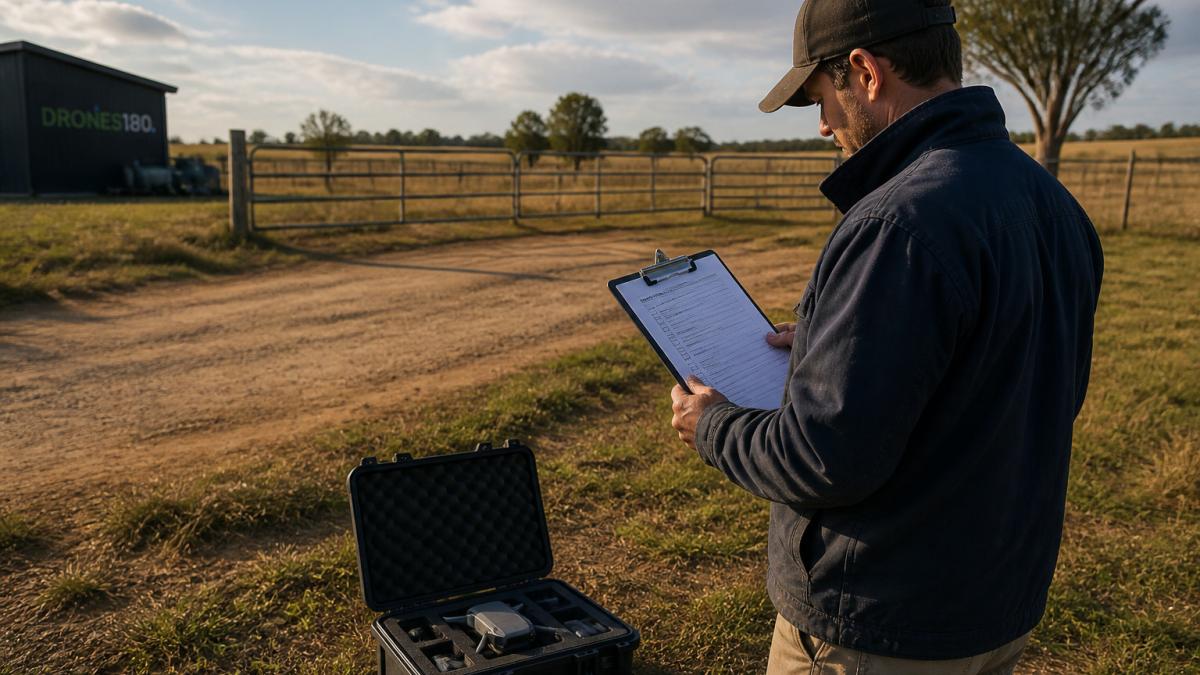
Use this checklist before each business flight:
- Confirm the flight purpose and whether it is business use
- Check the drone weight with payload and batteries
- Check airspace restrictions, airports and helipads using an approved tool
- Identify people on or near the site, including workers, neighbours and livestock handlers
- Confirm you have permission to fly over each property involved
- Choose a take-off and landing area clear of people and hazards
- Check weather, wind and visibility
- Confirm the drone is serviceable and the batteries are charged
- Confirm visual line of sight can be maintained for the whole flight
- Record any risks identified and the controls you put in place
Adapt the list to your property. A dairy farm, a mine site and a subdivision carry different hazards, and your assessment should reflect that.
Drone Operations Manual and Flight Records You Should Keep
Good records are your proof of compliance and your protection if something goes wrong. CASA expects business operators to keep records that show how each flight was planned, flown and reviewed. The good news is that a simple, repeatable system beats a thick folder nobody updates.
What to keep
At a minimum, keep these records for every business flight:
- Operations manual or documented procedures, your written way of doing things, including your pre-flight checks, emergency steps and record-keeping process.
- Pre-flight risk assessment, the checklist you complete before each flight, signed and dated.
- Flight log, date, location, take-off and landing times, pilot name, drone registration or serial number, purpose of flight and any incidents.
- Maintenance and battery records, service dates, repairs, battery cycles and defects.
- Incident and near-miss records, what happened, when, who was involved and what you did about it.
- Insurance certificates and licence details, current copies kept with the rest of your records.
A simple record workflow
You do not need expensive software. A folder on your phone or a ring-binder in the ute works, as long as it is consistent.
- Before the flight: complete the risk assessment and save it with the date and site name.
- During the flight: note take-off and landing times and any issues in the flight log.
- After the flight: file the log, note any maintenance items and flag anything that needs follow-up.
- Monthly: review the folder, check maintenance is up to date and archive the previous month.
- Annually: review your operations manual against current CASA guidance and update it.
How long to keep records
As a practical rule, keep flight and maintenance records for at least the period CASA requires for your operation, and longer if your insurer or client contracts ask for it. If you are unsure, check the current CASA record-keeping guidance for your pathway and keep records for the longer of the two periods.
Make it work on the land
The best record system is the one you will actually use. Keep a printed checklist in the ute, use a phone app for flight logs if that suits you, and back up digital records regularly. A dairy farm, a mine site and a subdivision have different hazards, so adapt your templates to your work rather than copying someone else's.
Sample flight log fields
A simple flight log can be a table with these columns:
| Date | Site | Pilot | Drone ID | Take-off | Landing | Purpose | Issues |
|---|---|---|---|---|---|---|---|
| 14/03/2025 | Paddock A | J. Smith | DJI-001 | 07:10 | 07:35 | Crop check | None |
Keep the table simple and fill it in every time. A complete simple log is worth more than a detailed one you only fill in occasionally.
Insurance, Incidents and What to Do If Something Goes Wrong
Business drone work should be covered by appropriate insurance. Read each policy carefully, because exclusions can leave you exposed.
If an incident happens, such as a crash, injury, or a drone lost near people or property:
- Make the area safe and check for injuries
- Report serious incidents as CASA requires
- Notify your insurer promptly
- Preserve flight logs, footage and records
- Review what happened and update your procedures
Acting quickly and keeping good records makes a real difference to both safety and your insurance position.
Your Next Step: Getting Your Drone Operation Compliant
Work through this guide against your own operation. If you are setting up a new fleet, getting started and support covers initial setup, calibration, familiarisation and ongoing technical help. Decide which pathway applies, complete your risk assessments and set up your records before your next business flight.
If you would rather focus on the work and leave the compliance paperwork to specialists, DRONES180 supplies commercial drone solutions with setup and ongoing support. Request pricing for DJI Enterprise and DJI AGRAS systems, or book a demonstration to see a drone working in your own conditions before you invest.
Frequently Asked Questions
What CASA rules apply when using a drone for business?
If you fly a drone to earn money, for a client, or as part of a business, CASA treats it as a commercial operation, not a recreational one. That means your flights must follow the rules for the operation type you fall under, which depends on the drone's weight and the risk of the task. Start by checking whether your flight fits the excluded category. If it does not, you will need the approvals CASA requires for that operation. Keep your operations within the conditions CASA sets, including visual line of sight and the distance you keep from people and property.
Do I need a licence to fly a drone for commercial work?
In most cases, yes. Flying a drone for business without the right authorisation can breach CASA rules, even if the drone is small. Some low-risk operations may fall in the excluded category, but you still need to meet its conditions. Check the current CASA requirements for your drone's weight and the work you plan to do before you take a booking. If you are unsure, confirm with CASA directly rather than relying on general advice.
When does a business drone operator need a remotely piloted aircraft operator's certificate?
Higher-risk commercial operations that do not fit the excluded category need the approvals CASA sets for them. Operations near people, over populated areas, or in more complex environments usually sit outside the excluded category. Your flight planning, risk assessment and operations manual all feed into whether an ReOC is required. Work out which category your operation falls under before buying equipment or taking work, because the approval process takes time.
Can I fly a drone for work on my own property without approval?
Owning the land does not remove CASA's rules. If the drone is used for business, such as spraying crops for a neighbour, mapping a site for a contractor, or inspecting infrastructure you own for commercial reasons, the commercial rules still apply. Flying on your own property for private, non-commercial purposes is treated differently, but the lines blur quickly once money or a service is involved. Keep records that show the purpose of each flight so you can prove which rules applied.
