
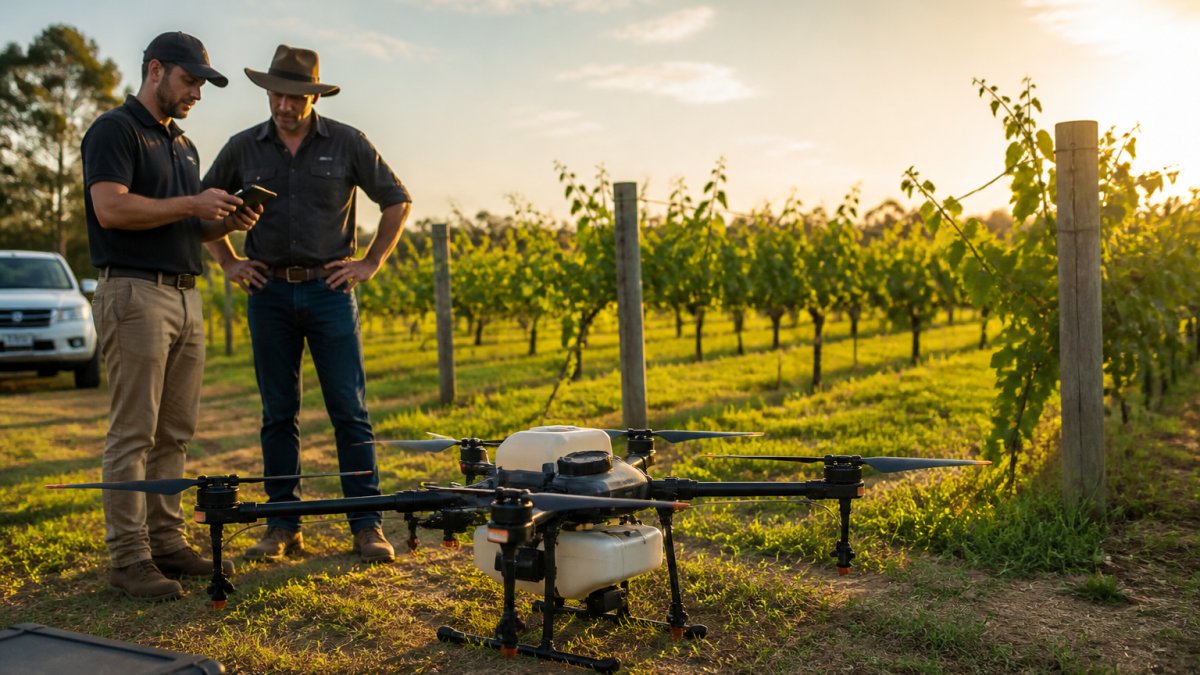
Last Updated: November 2, 2026
Quick Summary
To choose a spray drone for a vineyard, first measure your row spacing, trellis height, headland width, slope and wind conditions, then match tank capacity and battery count to your block size and daily hectares. Calibrate the spray drone with water-sensitive cards at three canopy heights before spraying the whole block.
- Measure row spacing, trellis height and headland width on your worst block, not your best one.
- Plan in hectares per day, not minutes per flight, and treat two or three batteries as the practical minimum.
- Set water-sensitive cards at top, mid and fruit zone on sunny and shaded sides of the row.
- Check wind speed and direction at the block before every load, not at the shed.
- Confirm the chemical label permits aerial application and check CASA and state rules before buying.
Table of Contents
- Start With Your Vineyard, Not the Brochure
- Spray Drone Tank Capacity: How Much You Can Carry Per Load
- Spray Drone Battery Life and Daily Hectares
- Spray Drone Droplet Size and Coverage on the Vine Canopy
- Spray Drone Calibration: Getting the Rate Right Before You Fly
- Compliance, Crew and What Support You Need Behind the Drone
- Frequently Asked Questions
Start With Your Vineyard, Not the Brochure
Most spray drone buyers start with a spec sheet. That is the wrong end of the problem. Start by measuring the block you intend to fly.
A spray drone is a low-volume precision sprayer that flies a set path over your vines and delivers droplets through nozzles under the rotors.
Before you compare models, walk the vineyard and write down four things.
Row Spacing, Trellis Height and Headland Width
Row spacing decides how much of your block the drone can actually treat. Narrow rows mean the downwash has less room to work, and the flight path has to be tighter.
Trellis height matters too. Taller canopies need the drone to fly higher and slower to get coverage through the leaves. Headland width is the one most buyers forget.
Measure these three things on your worst block, not your best one.
Slope, Terrain and Weather Limits
Slope changes everything. Steep country can push the drone off its planned line and make the spray pattern uneven.
Wind is the other limit. Most spray work needs calm to light conditions. If your spray window is usually windy, plan around early mornings and short flights.
A common mistake is buying for the flat block out the front and then finding the back paddock is unusable.
Spray Drone Tank Capacity: How Much You Can Carry Per Load
Tank capacity sets your refill rhythm. A bigger tank means fewer stops, but also more weight and a shorter flight.
Choosing the Best Spraying Drone for Your Farm / Business
Raptor Dynamic
Match tank size to your block size. Small, tight blocks suit a smaller tank because you are turning and refilling often anyway.
If you want to compare Agras tank sizes and models side by side, our team can walk you through the DJI AGRAS range and how each one suits different block layouts.
Watch out: buying the biggest tank you can afford often means you carry more weight than your rows and terrain can handle.
Spray Drone Battery Life and Daily Hectares
Flight time and battery life decide your daily spraying target. A single battery gives you a set window of flying time, then you land, swap and go again. Plan in hectares per day, not minutes per flight.
Work it out this way:
- Measure your sprayable hectares per block
- Time one full tank on one block
- Add refill time and battery swap time
- Multiply by the number of batteries you own
- Subtract for wind, heat and travel between blocks
Many growers find two or three batteries are the practical minimum. Battery swap speed and refill workflow matter more than the headline flight time on the box.
Spray Drone Droplet Size and Coverage on the Vine Canopy
Droplet size and coverage are where cheap setups fail. Fine droplets give good coverage but drift easily. Coarse droplets land where you aim but can run off the leaf.
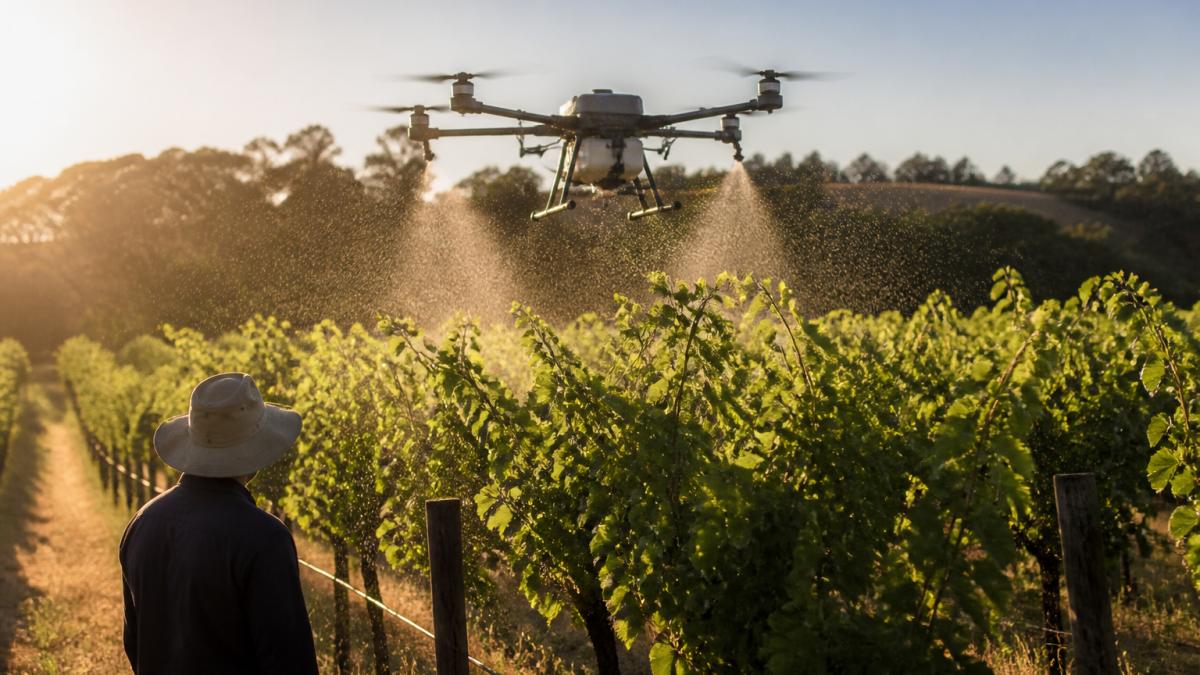
Canopy penetration is the hard part. Vine canopies are dense, and getting spray onto the underside of leaves and into the fruit zone takes the right droplet size, height and speed.
Spray Drone Calibration: Getting the Rate Right Before You Fly
Calibration decides whether your spray rate is right. It sets the application rate, droplet size and flight speed so the label rate actually lands on the vine. On a vineyard it is the difference between a clean block and a wasted load.
The process is simple but it must be done properly:
- Set the target application rate from the chemical label
- Set droplet size for your canopy density
- Set flight speed and height for your row spacing
- Test on a small area with water-sensitive cards
- Check coverage on top and underside of leaves
- Adjust and repeat before spraying the whole block
Field Tests That Actually Tell You Something
A calibration that only checks one row is not a calibration. Set out water-sensitive cards at three heights in the canopy, top, mid and fruit zone, and on both the sunny and shaded sides of the row.
Repeat the test at the start, middle and end of a block. Coverage often drifts as the tank empties and the aircraft gets lighter, so the last rows get a different rate to the first.
Droplet Size, Drift and Deposition
Droplet size is a trade-off you cannot avoid. Fine droplets give better coverage of leaf undersides and the fruit zone, but they hang in the air and drift.
Deposition is the number that matters. After a test pass, check how much product is on the leaf versus on the ground. Heavy pooling on the soil under the vines means your rate is too high or your droplets are too coarse.
Drift and Weather Checks Before Every Load
Calibration is not a one-off. Wind, temperature and humidity change through the day, and so does your spray pattern.
You can see what setup, calibration and ongoing support covers with DRONES180 before you commit to an aircraft.
Watch out: skipping calibration, or calibrating once and never again, is the fastest way to waste chemical and get poor results.
Calibration is a repeatable process, and each step has to be done in order before you spray the whole block.
| Step | What to do |
|---|---|
| 1 | Set the target application rate from the chemical label |
| 2 | Set droplet size for your canopy density |
| 3 | Set flight speed and height for your row spacing |
| 4 | Test on a small area with water-sensitive cards |
| 5 | Check coverage on top and underside of leaves |
| 6 | Adjust and repeat before spraying the whole block |
Compliance, Crew and What Support You Need Behind the Drone
Spraying from the air is regulated work. In Australia, commercial drone operations sit under CASA rules, and chemical use sits under the label and your state rules. You need the right licences, the right insurance and a crew that knows the workflow. The rules are there so your neighbour's crop, your workers and your own block stay safe.
Before you buy, work through this checklist:
- Confirm the CASA requirements for commercial spraying
- Check the chemical label allows aerial application
- Confirm storage, mixing and disposal rules
- Plan crew roles: pilot, spotter, mixer
- Confirm insurance covers spraying work
Chemical Labels and Aerial Application
Not every product is registered for aerial application, and the label is the law. Read the label before you buy the drone, not after. Look for the aerial application rate, the permitted droplet size, any buffer zones and any restrictions on wind speed or temperature.
State and territory rules sit on top of the label. Some jurisdictions require notification before aerial spraying, some restrict it near sensitive areas, and some have record-keeping requirements.
Drift Mitigation and Neighbour Relations
Drift causes the most trouble. Before you spray, identify anything downwind that could be affected: waterways, dams, livestock, beehives, neighbouring vineyards, sensitive crops and houses. Set a buffer distance you will not cross and stick to it.
Talk to your neighbours before the season starts. A quick conversation about when you plan to spray and what you are using prevents most complaints.
Crew Roles and Safety
A spray drone is not a one-person tool on a working block.
If the regulatory side feels heavy, read our practical guide to CASA rules for business before you commit. DRONES180 holds CASA ReOC 9681 and ARN 1303301, and offers setup and calibration support.
Watch out: assuming the label and the CASA rules are the whole story, state restrictions and local buffer rules can catch you out on your first job.
Frequently Asked Questions
What should I look for in a vineyard spray drone?
Start with the vineyard, not the spec sheet. Check that the spray drone fits your row spacing and trellis height, that the tank capacity suits how many hectares you want per refill, and that battery life matches your daily spraying target. Then confirm droplet size and coverage suit your canopy, and that calibration and support options are available. A drone that flies well but cannot be calibrated to your rows will not earn its keep.
Can spray drones work between narrow vineyard rows?
Yes, but row spacing decides how. Measure your narrowest row and your trellis height before you buy, and ask for a demonstration over your own rows. Headland width also matters, because the drone needs room to turn and refill at the end of each run.
How do I choose the right tank capacity for vineyard spraying?
Work backwards from your daily spraying target. Estimate how many hectares you want to cover in a session, then how many litres that needs at your application rate, then how many refills you are willing to do. A larger spray drone tank capacity means fewer stops but more weight and a bigger transport footprint. A smaller tank suits smaller blocks and awkward terrain where refill points are close together.
What training and approvals are needed to operate an agricultural spray drone?
In Australia, agricultural spraying by drone sits under CASA aviation rules and the chemical label requirements for the product you apply. Ask your supplier what operator training, remote pilot licensing and chemical handling requirements apply to your setup, and confirm insurance covers spraying work.
If your rows are tight, your slopes are steep and your spray window is short, the wrong aircraft will sit in the shed. Talk to DRONES180 about your block layout, and we will match you to the right AGRAS model with setup, calibration and ongoing support behind it. Get started with DRONES180 and put a spray drone to work on the blocks that actually need it. Book a demonstration to see one flying in your own conditions before you invest.
